Spread bets and CFDs are complex instruments and come with a high risk of losing money rapidly due to leverage. 70% of retail investor accounts lose money when trading spread bets and CFDs with this provider. You should consider whether you understand how spread bets and CFDs work, and whether you can afford to take the high risk of losing your money.
UK Regulated Stockbroker Since 2009 | Client funds held with IG | FSCS protection up to £85,000 | Best CFD Broker 2026


SPREAD BETTING | PRACTICAL TRADING
From Market Selection to Closing a Trade
learn the practical process of placing and managing a financial spread bet through the IG trading platform, available to Guardian Stockbrokers clients.
Follow ten essential stages, from choosing a market and assessing trading opportunities to understanding dealing prices, setting your stake, using risk-management tools and closing a position.
IN THE GUIDE
01
Choose a Market
Selecting the right financial market before placing a spread bet
The first decision when spread betting is which financial market to trade. Through the IG trading platform, Guardian Stockbrokers clients can access a broad range of instruments, including UK and international shares, stock indices, foreign exchange and commodities. Although the basic trading process is similar, the characteristics of these markets can differ considerably.
Market selection should begin with an understanding of what drives prices and how the instrument behaves. A major stock index such as the FTSE 100 responds to developments across its constituent companies and the wider economy, while an individual share can react sharply to company results, trading updates or regulatory announcements. Currency markets are influenced by interest rates and economic expectations, whereas commodities such as crude oil can experience substantial movements following changes in supply, demand or geopolitical conditions.
A sensible starting point is to concentrate on a market you understand and can follow consistently. Choosing an instrument simply because it has recently experienced a large price movement may expose you to volatility without a clear understanding of the factors behind it.
Finding a Market on the Platform
Once you've identified an instrument of interest, open the IG trading platform and use the search function or market categories to locate it. Select the relevant spread betting market and review its dealing information before considering a position.
Pay particular attention to the market's trading hours, typical price movements, current spread, minimum stake and margin requirement. You should also establish whether the position is offered as a Daily Funded Bet or a contract with a specified expiry, as the pricing and costs of maintaining a position can differ.
Trading hours are especially important. Some major indices and currency markets offer extended dealing, while individual shares generally follow their relevant exchange sessions, subject to any additional out-of-hours facilities. Spreads and liquidity can also change throughout the trading day.
Markets Available to Trade


Having selected a market, make sure you understand its dealing conditions and the financial effect of its typical price movements. The amount of margin required to open a position should never be mistaken for an indication of how much can be lost.
Concentrating initially on one or two familiar markets can help develop a clearer understanding of their behaviour before considering other instruments.
The next step is to assess whether the market presents a trading opportunity, rather than placing a position simply because it is available to trade.
02
Find an Opportunity
Identifying potential trading opportunities through market research and analysis
Once you have selected a financial market, the next stage is to determine whether there is a reason to consider taking a position. Financial markets move in response to economic developments, company announcements, changes in investor expectations and shifts in supply and demand. Identifying a potential opportunity involves understanding what is driving those movements and assessing whether the prevailing conditions support a trading decision.
A significant price movement does not necessarily represent an attractive opportunity. Markets can react quickly to new information, and by the time a development becomes widely reported, much of its immediate effect may already be reflected in the price. Research should therefore focus on understanding the circumstances behind a movement rather than simply reacting to its size or direction.
Understanding What Is Moving the Market
Fundamental analysis examines the economic and financial factors influencing market prices. For share traders, these may include company results, trading statements, broker recommendations, earnings forecasts and developments affecting a particular industry. For indices and currencies, central bank decisions, inflation figures, employment data and changes in interest rate expectations are often important influences.
Guardian's Daily Market Report provides a starting point for reviewing developments across UK, US and international markets, together with the economic events and corporate announcements likely to attract attention during the trading day.
The platform also provides access to market news, analysis and an economic calendar. Before considering a position, check whether important announcements are scheduled, particularly where the release could materially affect the market being traded. Unexpected figures or policy decisions can produce rapid price movements, wider dealing spreads and increased volatility.
Reviewing Price Charts and Market Conditions
Having established the background, examine the market's price chart to understand how it has been trading. Consider whether prices have been rising, falling or moving within an established range, and how the current quotation compares with recent highs and lows.
Areas of previous support and resistance, together with changes in trading momentum, can help identify prices at which market participants have previously shown buying or selling interest. However, historical price behaviour does not guarantee how a market will respond in the future.
The platform's charting facilities allow traders to examine different timeframes and apply technical indicators, including moving averages, Bollinger Bands and the Relative Strength Index (RSI). These tools can provide additional context, but their signals should be assessed alongside market conditions and relevant fundamental information rather than treated as reliable predictions.
Detailed approaches to technical analysis and trading strategies are covered separately in Guardian's How to Spread Bet
Successfully material.
Using Trading Alerts and Market Research
It is not necessary to monitor every market continuously. The platform allows traders to create price-level, price-change and technical indicator alerts, while economic calendar alerts can provide notifications of scheduled announcements and their results.
For example, a trader monitoring the FTSE 100 may wish to receive an alert if the index reaches a previously identified price level. This provides an opportunity to reassess the market without having to watch the chart throughout the trading session.
To set a price alert on the web platform, select the relevant market, open its dealing ticket and choose the Alert tab. Enter the price condition and select Set Alert. Alerts notify you when specified conditions are met; they do not automatically open a trading position.
Market commentary, research and trading signals can help identify developments worth investigating, but they should not replace an independent assessment of the potential risks and costs.
Assessing Whether an Opportunity Is Worth Trading
Before progressing to the next stage, establish what has attracted your attention to the market, whether the relevant information is already reflected in its price, and whether upcoming announcements could change the outlook.
An important part of trading is recognising when conditions do not justify opening a position. Unclear price movements, unusually wide spreads or significant uncertainty surrounding an imminent announcement may provide good reasons to wait rather than trade.
Once a potential opportunity has been identified, the next decision is whether the evidence supports taking a long position, a short position or no position at all.
03
Go Long or Short
Deciding whether to buy or sell a financial market
Once you have identified a potential trading opportunity, the next decision is whether to take a long or short position. Spread betting allows you to speculate on both rising and falling market prices without owning the underlying financial instrument.
The direction of your trade should follow your assessment of the market rather than an assumption that prices will continue moving in their recent direction. A positive economic announcement does not necessarily result in a rising market, just as disappointing company results do not always produce an immediate decline. Financial markets respond to expectations as well as the information itself.
Going Long: Buying a Market
A long position is opened when you expect the price of a financial market to rise. On the IG trading platform, this means selecting the Buy price.
For example, suppose the FTSE 100 is quoted at 8,100 to sell and 8,101 to buy. A trader anticipating a rise would open a long position at the quoted buying price of 8,101. If the market subsequently rises sufficiently, the position can be closed at a higher selling price to realise a trading profit. If the market falls, closing the position at a lower price results in a loss.
The important distinction is that you are not purchasing the shares making up the FTSE 100. You are entering into a financial contract whose value changes with movements in the quoted index price.
Going Short: Selling a Market
A short position is opened when you expect a market price to fall. On the IG platform, this means selecting the Sell price.
Using the same FTSE 100 quotation, a trader expecting the index to decline could open a short position at 8,100. If the market subsequently falls, the position can be closed by buying at a lower price, producing a trading profit. If the index rises instead, closing at a higher buying price produces a loss.
This ability to trade falling markets is an important feature of spread betting. Unlike conventional share ownership, you do not need to purchase the underlying shares before opening a sell position. However, short positions remain subject to the provider's dealing conditions, including any market-specific restrictions.
The risks are not lower simply because a trader is selling rather than buying. Both directions create exposure to potentially significant losses when markets move adversely.
Selecting Buy or Sell on the Platform
Having decided on a trading direction, locate your chosen market on the IG platform and open its dealing ticket.
The ticket displays two prices:
SELL: The price at which you can open a short position or close a long position.
BUY: The price at which you can open a long position or close a short position.
Select the appropriate direction and review the displayed dealing price. The difference between the two quotations is the spread, which varies according to the instrument and prevailing market conditions.
The dealing ticket also allows you to specify your stake, review margin requirements and set instructions for managing the position. These are important decisions that should be completed and checked before submitting a trade.
If you already hold a position in the same market, be aware that IG's Net Off and Force Open settings can determine whether an opposing trade reduces an existing position or opens a separate one. Check the applicable setting rather than assuming that selecting Buy or Sell will always create a new position.
Before Moving to the Next Stage
Choosing the direction of a trade is only one part of establishing a spread betting position. Before proceeding, you should understand the price at which the trade would be opened, the price needed to close it and the effect of the spread on the position.
The next stage is to examine the buying and selling prices in more detail and understand how the spread affects the cost of trading.
04
Understand the Spread
Checking buying and selling prices before placing a spread bet
Before opening a spread bet, it is important to understand the two prices displayed on the IG dealing ticket and how they affect the cost of entering and exiting a position. Every spread betting market has a quoted selling price and buying price, with the difference between them known as the spread.
The Sell (bid) price is the price at which you can open a short position, while the Buy (offer) price is the price at which you can open a long position. The buying price is normally higher than the selling price, and this difference represents an important component of the cost of trading. Understanding how these prices operate is essential because the price at which you close a position is on the opposite side of the quotation from the one used to open it.
Reading the Spread on the Dealing Ticket
The genuine IG spread betting screenshot below shows the FTSE 100 Cash market on 14 October 2026, with the following quoted dealing prices:
SELL: 10,656.5
BUY: 10,657.5
SPREAD: 1 point
The dealing ticket also displays a stake of £6 per point, meaning that each point of market movement changes the position's trading profit or loss by £6.
If you open a long position at 10,657.5 and immediately close it at the unchanged selling price of 10,656.5, the one-point difference produces a £6 trading loss.
The same applies to a short position. Selling at 10,656.5 and immediately buying back at 10,657.5 would also result in a £6 loss.
In both cases, the spread is already reflected in the opening and closing dealing prices. It should not be deducted a second time when calculating the trading result.

IG FTSE 100 Cash dealing ticket, 14 October 2026. Historical prices shown for educational purposes only. The example excludes additional trading charges and adjustments.
Understanding the Cost of the Spread
The spread is incorporated into the quoted dealing prices rather than normally being charged as a separate transaction fee. In our FTSE 100 example, the one-point spread represents £6 at the selected stake of £6 per point.
For a long position opened at 10,657.5, the selling price would need to rise to 10,657.5 before the position breaks even on its trading price. Any further favourable movement would generate a trading profit, while a move in the opposite direction would increase the loss. The same principle applies in reverse when holding a short position.
Although the spread is an important cost, it is not necessarily the only one. Overnight financing on Daily Funded Bets, currency conversion and other applicable charges or adjustments may affect the overall result. Traders should therefore consider both the immediate dealing cost and any additional costs associated with maintaining their position.

Why Spreads Change
Spreads vary between financial instruments and can change throughout the trading day according to liquidity, volatility and prevailing market conditions. Major stock indices and heavily traded currency pairs may offer relatively narrow spreads during their busiest sessions, while individual shares and less liquid markets can have considerably wider quotations.
Periods of heightened volatility require particular attention. Company announcements, economic releases and unexpected geopolitical developments can cause prices to move rapidly and spreads to widen as liquidity changes. Trading outside the main underlying market hours can also involve different dealing conditions.
Daily Funded Bets and futures-based spread bets may have different quoted spreads because their contract structures and financing arrangements differ. A narrower dealing spread should not automatically be interpreted as a lower overall cost without considering the intended holding period and other applicable charges.
Checking the Price Before You Trade
Before opening a position, confirm that you have selected the intended market and contract type, then review the current buying and selling prices, spread and any relevant dealing conditions. The platform provides market information and indicative cost details that can help traders assess the transaction before submitting an instruction.
Quoted prices can change rapidly, particularly around economic announcements or periods of market volatility. The price displayed when you initially open a dealing ticket may therefore differ from the price available when your order is executed. It is the actual execution price that determines the opening level of your position.
Having established how the spread affects the cost of trading, the next stage is to decide the appropriate stake per point and understand the financial exposure it creates.
05
Set Your Stake
Choosing your position size and understanding the financial impact of market movements
Choosing your position size and understanding the financial impact of market movements
Once you have selected a market, decided whether to go long or short and checked the dealing spread, the next step is to determine the size of your position. In spread betting, this is expressed as a monetary stake per point of market movement, rather than the number of shares or units you wish to purchase.
Your stake determines how much your trading profit or loss changes for every point the market moves. Choosing an appropriate position size is therefore one of the most important decisions when placing a spread bet. It should reflect the financial exposure you intend to take, the volatility of the market and the amount of loss you can reasonably afford to sustain.
Setting Your Stake on the Platform
The spread betting dealing ticket contains a Size field, displayed in pounds per point (GBP/£). Enter the monetary amount you wish to stake, subject to the minimum size and dealing requirements for the selected market.
In our genuine FTSE 100 example from Section 04, the dealing ticket shows a stake of £6 per point. This means that every one-point movement in the value of the position changes the trading profit or loss by £6, depending on whether the movement is favourable or adverse.
A 10-point movement would represent £60, while a 50-point movement would represent £300. These amounts apply equally to potential gains and losses, before any additional charges or adjustments.
The same underlying market movement can therefore produce very different financial results depending on the stake selected. Increasing the stake increases both potential profits and potential losses in direct proportion.
FTSE 100 | £6-per-point stake

Illustrative changes between executable dealing prices, excluding additional charges and adjustments.
Assessing the Financial Risk Before Trading
Position sizing should be considered in the context of the market's normal volatility and the potential consequences of an unexpected movement. A 50-point change might be relatively modest for one market under certain conditions but represent a substantial movement in another. The importance of that movement also depends on the monetary stake attached to each point.
For example, at £6 per point, a 100-point adverse movement would produce a £600 trading loss. Increasing the stake to £10 per point would increase the loss from the same movement to £1,000. The market itself has not become more volatile; the trader has simply increased the financial exposure.
Before submitting a trade, consider how different adverse price movements would affect your available funds and whether the potential loss is consistent with your financial circumstances. The minimum stake offered by a provider should not automatically be treated as an appropriate position size.
Position Size Is Not the Same as Margin
It is important to distinguish between the monetary stake, the total market exposure and the margin required to open a position.
The stake determines the financial effect of each point of movement. The total market exposure reflects the underlying value of the position, while margin represents the amount of capital the provider requires to support it.
For an index spread bet, the approximate underlying market exposure can be illustrated by multiplying the index level by the stake per point. In our FTSE 100 example, a buying price of 10,657.5 and a £6-per-point stake represent approximately £63,945 of market exposure.
This does not mean that £63,945 must be deposited to open the trade. Spread betting uses leverage, so only a proportion of that exposure is normally required as initial margin. However, profits and losses remain linked to movements in the full position, not simply the initial deposit.
Confirming Your Stake Before Placing a Trade
Before proceeding, check that the amount entered in the Size field matches your intended stake and that you understand the monetary consequences of a favourable or adverse market movement.
Review the minimum stake, applicable dealing conditions and any intended stop-loss level. An ordinary stop-loss can help manage risk, but it does not guarantee that a position will close at the selected price.
The stake should be chosen deliberately, rather than increased simply because the account has sufficient funds to meet the initial margin requirement.
Once the position size has been established, the next step is to understand how leverage affects the relationship between your market exposure and the capital required to support the trade.
06
Understand Leverage
How leverage increases market exposure and magnifies trading profits and losses
Leverage is one of the defining characteristics of financial spread betting. It allows traders to establish a position representing a substantially greater market value than the amount of capital initially required to open it. Instead of paying the full underlying value, the trader deposits a proportion of that exposure as margin, while remaining financially exposed to movements in the entire position.
This can provide flexibility when allocating trading capital, but it also introduces significant risk. The financial consequences of a market movement are determined by the size of the position, not by the amount deposited to support it. Understanding this distinction is essential before opening a leveraged trade.
How Leverage Works in Practice
The amount of leverage available depends on the financial instrument, the applicable margin rate and the client's regulatory classification. For UK Retail clients, major stock indices such as the FTSE 100 generally have a minimum initial margin requirement of 5%, equivalent to maximum leverage of 20:1.
This means that, at the applicable minimum margin rate, every £1 of initial margin can support approximately £20 of underlying market exposure. However, this does not mean that the trader's potential loss is limited to the £1 deposited.
IG also operates tiered margining, which means larger positions may require proportionately more margin. The actual requirement must always be checked against the relevant market and position size.
Worked Example: FTSE 100 at £6 Per Point
FTSE 100 | Illustrative 20:1 leverage

Illustrative figures using £6 per point and the minimum 5% retail FTSE 100 margin rate. Actual margin requirements may be higher. Figures exclude additional trading costs.
Using the genuine IG dealing ticket from Section 04, suppose you open a long position on the FTSE 100 at a buying price of 10,657.5, with a stake of £6 per point.
The approximate market exposure is calculated as follows:
10,657.5 × £6 = £63,945
At an illustrative 5% margin requirement:
£63,945 × 5% = £3,197.25 initial margin
The position therefore represents approximately £63,945 of market exposure, although only £3,197.25 would initially be required as margin under these assumed conditions.
This is equivalent to leverage of 20:1.
If the executable closing price moves 100 points above the opening price of a long position, the trading profit would be £600. A 100-point movement in the opposite direction would produce a £600 loss, excluding additional charges and adjustments.
The £600 loss would represent approximately 18.8% of the illustrative initial margin, even though the FTSE 100 had moved by less than 1% from the opening level.
This demonstrates how leverage magnifies the financial effect of relatively small movements in the underlying market.
Example based on historical IG prices from 14 October 2026. The 5% margin assumption is illustrative; actual requirements depend on the position and applicable dealing conditions.
Why Leverage Requires Careful Consideration
The effect of leverage becomes particularly important during periods of market volatility. Economic announcements, central bank decisions, company developments and geopolitical events can produce rapid movements in financial prices, sometimes before a trader has an opportunity to respond.
A leveraged position can lose value quickly when the market moves against it. Several positions exposed to related markets can also create greater overall risk than may be apparent when assessing each trade individually.
Although leverage can increase profits relative to the initial margin deposited, it magnifies losses in exactly the same way. Increasing a position simply because the account has sufficient margin can result in exposure that is disproportionate to the trader's available capital.
For UK Retail clients, negative balance protection limits relevant trading losses to the funds in the associated trading account, but does not prevent those funds from being lost.
Understanding Leverage on the IG Platform
Before placing a spread bet, the IG dealing ticket allows you to enter your stake and review the margin required for the proposed position. The applicable margin rate can also be found within the market's dealing information.
It is important to consider the full position rather than viewing the margin figure in isolation. Two trades requiring the same initial deposit can have different exposure characteristics, particularly where the instruments have different volatility, contract structures or margin requirements.
Traders should also be aware that margin requirements may change in response to market conditions and that maintaining open positions requires sufficient account equity.
Leverage determines how much market exposure can be established relative to the capital committed. It does not determine how much risk is appropriate for an individual trader.
Before Moving to the Next Stage
Before proceeding, establish the total market exposure associated with your chosen stake and consider how realistic adverse price movements could affect your trading account.
The initial margin represents the capital required to open the position, not a predetermined limit on trading losses.
The next stage is to understand how margin is calculated, how much available capital is required and what happens when an account can no longer support its open positions.
07
Check Your Margin
Understanding required margin, available funds and automatic position closure
Before placing a spread bet, you must establish how much margin is required and whether your trading account contains sufficient funds to support the position. Margin is the capital set aside to open and maintain a leveraged trade. It is not a separate dealing fee, nor does it represent the maximum amount that can be lost.
The margin required depends on the instrument, the size of the position, the applicable margin rate and the provider's dealing conditions. It is important to understand not only whether you have sufficient funds to open a trade, but also how adverse market movements could affect your ability to keep it open.
Checking Margin on the IG Dealing Ticket
The platform displays the margin requirement associated with a proposed position. Once you have selected a market and entered your stake, you can review the amount of capital required before submitting the trade.
Using our FTSE 100 example from Section 06, a £6-per-point position opened at 10,657.5 represents approximately £63,945 of market exposure. At an illustrative 5% margin requirement, the initial margin would be £3,197.25.
This amount is allocated to support the position, but it does not disappear from your account as a trading charge. Instead, it forms part of the funds required to maintain your open exposure. The actual margin displayed by IG may differ because of tiered margining, position size or other applicable dealing requirements.
Before proceeding, check both the required margin and the funds remaining available after the position is opened. An account containing only enough money to meet the initial requirement may have very little capacity to withstand an adverse market movement.
Account Equity and Available Funds
Your account equity reflects the value of your trading account, including unrealised profits and losses on open positions and applicable charges or adjustments. Required margin is the amount currently needed to support those positions, while available funds represent the remaining equity not committed to margin.
For example, suppose your account contains £5,000 and you open the FTSE 100 position requiring £3,197.25 of margin.
Assuming there are no other positions or charges, the account would have approximately £1,802.75 in available funds.
If the market subsequently moves 100 points against your £6-per-point position, the £600 unrealised loss would reduce account equity to £4,400. Assuming the margin requirement remains unchanged, available funds would fall to approximately £1,202.75.
The position remains open, but the account now has less capacity to absorb further adverse movements. A favourable movement would have the opposite effect on equity.
This is why available funds require attention throughout the life of a trade, not simply when it is first opened.
Illustrative FTSE 100 margin account

Illustrative figures assuming a constant £3,197.25 margin requirement, no other positions and no additional charges or adjustments.
What Happens During a Margin Call?
A margin call occurs when account equity falls below the margin required to maintain open positions. At IG, an account enters margin call when equity drops below 100% of the required margin.
This can happen because positions have moved against the trader, trading costs have reduced account equity or margin requirements have increased. Where several positions are open, the account's total exposure and overall margin requirement are relevant, rather than the position being considered in isolation.
A trader may respond by closing or reducing positions to lower the margin requirement, or by depositing additional funds. However, adding money increases the capital exposed to potential trading losses and should not be treated as an automatic solution to a deteriorating position.
IG aims to notify clients when their equity falls below specified margin levels, but notifications are not guaranteed. During rapidly moving markets, an account can move from adequate margin to automatic closure conditions before any warning is received.
The 50% Retail Margin Close-Out Rule
Under FCA rules, UK retail spread betting accounts are subject to an account-level margin close-out requirement. Providers must close open positions when account equity falls below 50% of the total margin required to maintain those positions, as soon as market conditions allow.
For illustration, if the total required margin remained at £3,197.25, the 50% level would be approximately £1,598.63 of account equity. This is not an additional fee or a guaranteed minimum account balance. It is the level at which the regulatory close-out requirement would apply under those assumptions.
The threshold can change if margin requirements change, and positions may be closed earlier under the provider's terms. Automatic closure can also occur during unfavourable market conditions, potentially crystallising substantial losses.
A margin close-out is therefore a regulatory safeguard, not a substitute for managing exposure. An account can incur significant losses well before reaching the 50% threshold.
Margin Requirements Can Change
Margin requirements are not necessarily fixed for the duration of a position. Providers may increase margin rates in response to heightened volatility, reduced liquidity or other market conditions. Larger positions may also be subject to higher requirements through tiered margining.
For example, if the margin requirement on an existing position increases, more of the account's equity may become committed to supporting that position even if the underlying market price has not moved significantly. This can reduce available funds and increase the risk of a margin call.
For this reason, it is important to monitor margin requirements, account equity and open positions regularly. Market gaps can also cause rapid losses, and ordinary stop-loss orders do not guarantee execution at a particular price.
UK retail clients benefit from negative balance protection, which limits relevant trading losses to the funds in the associated trading account. Nevertheless, this does not prevent those funds from being lost.
Before Moving to the Next Stage
Before submitting a spread bet, confirm that sufficient funds are available to meet the required margin and that the account has the capacity to withstand potential adverse market movements.
Consider the combined effect of existing positions, changing margin requirements and trading costs, rather than assessing each proposed trade solely on its initial margin requirement.
Having established the margin required to open and maintain a position, the next step is to select the appropriate contract duration and understand how that choice affects trading costs.
08
Choose Bet Duration
Understanding Daily Funded Bets, futures contracts and overnight financing
Once you have selected your market, trading direction and stake, the next consideration is how long you intend to hold the position. On the IG platform, spread betting markets may be available through different contract types, each with its own pricing structure, financing arrangements and expiry conditions.
The choice matters because two contracts referencing the same underlying market can have different dealing prices and holding costs. A position intended to remain open for a few hours may have different cost considerations from one expected to remain open for several weeks.
Daily Funded Bets (DFBs)
A Daily Funded Bet is designed to follow the cash price of the underlying market and has a distant nominal expiry rather than a conventional short-term expiry date. A DFB can ordinarily remain open across trading sessions, provided sufficient margin is maintained and the provider's dealing conditions continue to be met.
DFBs are commonly used for shorter-term trading because their dealing spreads may be narrower than those of equivalent futures-based contracts. However, positions held overnight are generally subject to daily financing adjustments.
On the IG platform, overnight funding applies to relevant DFB positions held through 10pm UK time. The calculation depends on the market, position direction, applicable interest rates and IG's funding arrangements. Some positions may receive a funding credit, although charges may still apply.
Funding can accumulate over time, so the total cost of maintaining a DFB becomes increasingly important where a position remains open for several days or weeks. Weekend funding adjustments and market-specific arrangements should also be considered.
Futures Based Spread Bets
Futures-based spread bets have a specified expiry date, which may be monthly, quarterly or another period depending on the market and contract available.
Unlike DFBs, futures-based spread bets do not normally incur a separate daily overnight financing adjustment. Instead, financing and other relevant holding-cost considerations are reflected in the contract's quoted price.
This means the futures quotation may differ from the corresponding cash market. The difference can reflect interest rates, expected dividends, the time remaining to expiry and other factors relevant to the underlying instrument.
Futures-based contracts may therefore be worth comparing when a position is expected to remain open for an extended period. However, the absence of a separate daily funding charge does not automatically make them cheaper. Dealing spreads, contract pricing and the intended holding period must all be considered.
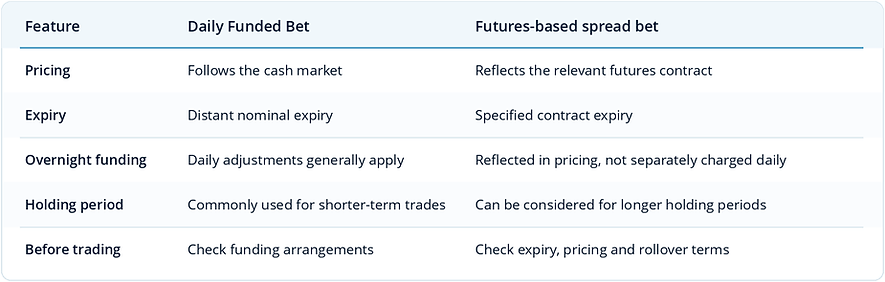
Understanding Expiry and Rolling a Position
A futures-based spread bet can usually be closed before expiry while the market is available for trading. If the position remains open until its expiry date, it will be settled according to the provider's applicable contract terms.
In some markets, IG offers the facility to roll a position into a later-dated contract. Rolling involves closing or settling exposure in the expiring contract and establishing exposure in the next contract, subject to the relevant pricing arrangements and charges.
The new contract may trade at a different price from the expiring one, and traders should not assume that the original entry price, stop levels or dealing conditions will remain unchanged.
The important point is that a futures position does not simply continue indefinitely. Its expiry and any intended rollover need to be understood and managed.
Selecting the Contract on the Platform
When viewing a market on IG, check which contract is selected before opening its dealing ticket.
For example, the FTSE 100 may be available as a cash-based Daily Funded Bet and through separate futures contracts. Although both provide exposure to movements in the index, they can have different quotations, spreads, financing arrangements and expiry dates.
Before placing the trade, confirm the contract type, current dealing prices, margin requirement and any applicable financing or expiry conditions. IG's market information and indicative cost details can help identify the relevant charges.
The expected holding period should inform the comparison, but it is not a commitment to keep the trade open for that length of time. Market conditions may change, and traders must retain the ability to reassess their exposure.
Before Moving to the Next Stage
Choosing the appropriate contract requires more than identifying the lowest initial dealing spread. The expected holding period, overnight adjustments, futures pricing and expiry arrangements all contribute to the overall cost and risk of a position.
Whichever contract is selected, leverage and margin requirements remain important, and a longer expiry does not reduce the risks associated with adverse market movements.
Having selected the contract type and understood its duration and costs, the next step is to establish how the position's risks will be managed before placing the trade.
09
Manage Your Risk
Using stop-loss orders, guaranteed stops, limits and trading alerts
Risk management is an essential part of placing and maintaining a spread bet. Financial markets can move rapidly, sometimes in response to unexpected economic announcements, company developments or changes in market sentiment. Because spread betting is leveraged, these movements can have a substantial financial effect on a trading account.
Before entering a position, traders should consider the potential consequences of an adverse market movement, the amount of capital they are prepared to risk and the tools available to manage their exposure. The IG platform provides several order types and monitoring facilities that can help, although no single tool removes the risks associated with leveraged trading.
Risk Management
Stop losses
Set a stop loss to close your position automatically if the market moves against you. Stop losses are free but your position may be closed out at a lower price than your order if the market gaps.
Guaranteed stop loss
Like a standard stop loss but guarantees that your order will be closed at the level requested by you. There is no cost to set up a guaranteed stop loss, But you will pay a small premium if it is triggered.
Trailing stop losses
No need to adjust your stop. A trailing stop will move with your profits. This allows you to potentially increase your profits as the price goes up whilst still retaining a stop loss at a set distance away. As with standard stop losses, trailing stops can be subject to slippage.
Alerts
Go about your business and let the system notify you of any price changes. When an instrument reaches your chosen price you will be notified by email or text.
Take profit with a limit order
Set your limit on an instrument and your position will be automatically closed if that limit hits your level.
1. Stop-Loss Orders
A stop-loss order is an instruction to close an open position if the market reaches a specified adverse price level. For a long position, the stop is placed below the relevant market price; for a short position, it is placed above it.
On the IG dealing ticket, select the Stop field and enter the required distance or level, subject to the minimum permitted for that market.
Using our FTSE 100 example, a trader opening a long position at 10,657.5 with a stake of £6 per point might consider a stop corresponding to an intended loss of 50 points, or £300. If the position closes exactly 50 points below its opening price, the trading loss would be £300 before additional costs.
An ordinary stop-loss does not guarantee that result. If the market moves sharply through the selected stop level, the position may close at a less favourable price. This is known as slippage, and it can occur particularly during sudden market movements or gaps between trading sessions.
2. Guaranteed Stop-Loss Orders
A guaranteed stop provides additional protection against slippage by ensuring that an eligible position closes at the specified stop level, even if the market gaps beyond it.
On IG, select Guaranteed from the Stop drop-down menu, where the facility is available. The platform displays the applicable minimum stop distance and potential premium.
IG charges the guaranteed stop premium only if the stop is triggered, although the potential premium is reserved alongside the margin while the position remains open.
Guaranteed stops can be particularly relevant when holding positions across market closures or significant scheduled announcements. However, the minimum permitted distance and availability vary by instrument, and the premium must be included when assessing the overall cost of the trade.
3. Trailing Stops
A trailing stop adjusts automatically when the market moves in a favourable direction, maintaining a specified distance from the market price according to the selected settings.
For example, a trailing stop attached to a long position can move upwards as the market rises, helping protect some of the favourable price movement if the market subsequently reverses. It does not move back down simply because the market falls.
Trailing stops may be useful when traders wish to allow a position to develop without continually adjusting a conventional stop-loss manually. However, they are not guaranteed stops and remain subject to slippage during rapid or gapping markets.
IG provides trailing stops on supported markets through the dealing platform, subject to the applicable order settings.
4. Limit Orders and Profit Targets
A limit attached to an open spread bet allows traders to specify a favourable price at which they would like the position to close.
For a long position, a closing limit is set above the current market price. For a short position, it is set below it.
The IG dealing ticket contains a Limit field, allowing traders to attach a profit-taking instruction before opening the position. This can help establish an intended exit level alongside a stop-loss, so that both favourable and adverse price scenarios have been considered.
A closing limit should not be confused with a pending order used to open a new position. The two instructions serve different purposes, and traders should confirm which type they are entering.
Setting a profit target does not guarantee that the market will reach it or that an order will necessarily be executed under all trading conditions.
5. Price Alerts and Monitoring Open Positions
Price alerts allow traders to receive notifications when a market reaches a specified level or meets other available conditions.
For example, someone monitoring the FTSE 100 could create an alert near an important price level, allowing them to review the market without watching the platform continuously. IG also provides facilities for monitoring open positions, account equity, margin requirements and unrealised profits or losses.
An alert is not a stop-loss. It notifies the trader but does not automatically close a position or restrict the amount that can be lost.
Stops and limits can generally be reviewed and amended through the platform's open positions area, subject to the provider's dealing conditions. Changes should be checked carefully, particularly if market prices are moving quickly.
6. Managing Overall Account Exposure
Risk management extends beyond the instructions attached to an individual trade. Several positions may be affected by the same economic event, even when they involve different markets. For example, an unexpected change in interest rate expectations could influence share indices, currencies and commodities at the same time.
Traders should therefore consider their combined exposure, available account equity and the possibility of correlated losses. Stop-loss orders and other controls can help manage individual positions, but they do not replace an assessment of overall account risk.
UK Retail clients benefit from regulatory margin close-out and negative balance protection. These are safeguards applying to relevant accounts, rather than trading instructions that the client selects. They do not prevent the loss of funds held in the trading account.
Before Moving to the Next Stage
Before submitting a spread bet, review the proposed stake, dealing price, margin requirement and any attached stop-loss or limit instructions. Where a guaranteed stop is used, check its premium and applicable conditions.
A risk-management instruction should reflect the financial consequences of the trade, not simply be placed at an arbitrary distance from the market price.
Once the position and its risk-management arrangements have been checked, the final stage is to understand how to monitor and close the trade through the IG platform.
10
Close Your Trade
Closing a spread betting position, confirming execution and reviewing the final result
The final stage of a spread bet is closing the position. Whether a trade has moved in your favour or against you, the result is only realised when the position is closed, either through a manual instruction, an attached order, automatic margin close-out or contract expiry.
Closing a position is more than deciding when to exit. Traders need to understand the dealing price at which the position will close, how to execute the instruction correctly and how the final profit or loss affects their account.
Closing a Position Manually on the Platform
To close an open spread bet on the web platform, navigate to the Positions section, where your current trades are displayed alongside their market, direction, size and unrealised profit or loss.
Locate the position you wish to close and select Close. Where confirmation is required, review the closing instruction and confirm it to execute the trade.
If one-click dealing is enabled, selecting Close may execute the instruction immediately without a separate confirmation. It is therefore important to check your platform settings and ensure that you have selected the correct position.
Closing a position requires dealing in the opposite direction to the original trade:
-
Long position: Sell to close.
-
Short position: Buy to close.
The IG dealing ticket also provides Net Off and Force Open settings for transactions in the opposite direction to existing positions. Net Off reduces or closes an opposing position, while Force Open can establish a separate position instead.
Using the dedicated Close function in the Positions panel helps avoid unintentionally opening additional exposure.
Calculating the Result of a Closed Trade
The trading result is calculated using the difference between the actual opening and closing execution prices, multiplied by the stake per point.
Consider the FTSE 100 position used throughout this guide, opened long at 10,657.5 with a stake of £6 per point.
If the position is subsequently closed at a selling price of 10,707.5, the 50-point favourable movement produces a £300 trading profit.
If the position is instead closed at a selling price of 10,607.5, the 50-point adverse movement produces a £300 trading loss.
These are illustrative closing prices, not historical quotations. The calculations use the actual sides of the dealing quotation, so the effect of the spread is already incorporated and should not be deducted a second time.
The final account result may also be affected by overnight financing, currency conversion, guaranteed stop premiums and other applicable charges or adjustments.
FTSE 100 | Closing a £6-per-point long position
Illustrative profit and loss from a 50-point market movement

Illustrative closing quotations. Additional charges and adjustments are excluded.
Closing Part of a Position
The platform also allows traders to close part of an existing spread bet, subject to minimum dealing sizes and the applicable market conditions.
For example, if you hold a long FTSE 100 position at £6 per point, you may choose to close £3 per point rather than the full position. This realises the trading profit or loss on the portion closed while leaving the remaining £3-per-point position exposed to subsequent market movements.
On the platform, selecting Close ordinarily provides the opportunity to specify the closing size before confirming the instruction.
Where one-click dealing is enabled, closing directly from the Positions panel can execute a full closure immediately. To reduce a position instead, IG provides an alternative method using an opposing dealing instruction with Net Off selected.
Traders should check the Net Off and Force Open settings carefully. An opposing trade entered with Force Open selected may create a separate position rather than reduce the existing exposure.
Automatic Closure Through Stops and Limits
Not every spread bet is closed manually. Positions may also close when an attached stop-loss or limit instruction is triggered.
A stop-loss is intended to close a position following an adverse movement, helping limit further exposure. However, an ordinary stop does not guarantee the execution price. If the market gaps or moves rapidly, the position may close at a less favourable level than the specified stop.
A guaranteed stop provides protection against this execution risk on eligible markets, subject to the provider's conditions and any applicable premium.
A closing limit is designed to close a position when a specified favourable price becomes available. The actual execution may be at the requested limit price or better, depending on market conditions.
Positions may also be closed automatically when an account can no longer meet the applicable margin requirements. Futures-based spread bets that remain open until expiry are settled according to their contract terms, unless an applicable rollover arrangement is made.
These different methods of closure can produce different outcomes, so traders should understand the instructions and conditions attached to each position.
Checking the Final Account Result
Once a position has been closed, its unrealised trading profit or loss becomes realised. The funds previously allocated as margin for the closed position are ordinarily released, although the account balance and available funds will reflect the trading result, applicable charges and any remaining open positions.
The final account result may differ from the simple price-movement calculation because of overnight funding, currency conversion, guaranteed stop premiums or other relevant adjustments.
On the platform, traders can review completed transactions through the account's History section and relevant account statements. Checking the executed opening and closing prices is particularly important where a position has been closed during volatile market conditions.
A useful review should establish whether the position closed at the intended level, whether attached orders operated as expected and how the final result compared with the financial risk originally assessed.
Reviewing the Completed Trade
Closing a position should also provide an opportunity to evaluate the trading decision.
Consider whether the original reasons for entering the trade remained valid, whether the chosen position size was appropriate and whether risk-management instructions were followed. A profitable trade is not necessarily evidence of a sound decision, just as an individual losing trade does not automatically mean the original analysis was unreasonable.
Maintaining an accurate record of trading decisions, executed prices, costs and outcomes can help traders identify recurring mistakes and assess how effectively they manage their exposure.
Closing a trade completes the transaction, but reviewing the result is an important part of developing a disciplined approach to financial spread betting.


Best CFD Broker 2026
Guardian Stockbrokers was named Best CFD Broker 2026 at the ADVFN International Financial Awards.


What our clients say
Trusted by traders across the UK
Professionalism, Responsiveness
Professional and proactive I’m really happy that they were recommended to me.
I would recommend Guardian Stockbrokers.
Professionalism, Quality,
Responsiveness, Value
I could not more highly recommend Guardian Stockbrokers, everyone has been brilliant. The attentiveness, training and technical detail provided, has enabled a fast track learning and an ability to manage the portfolio in a way that would far exceed my own capabilities.
Professionalism, Responsiveness
I've known Guardian Stockbrokers since their inception.
When dealing with trading, you want to work with people that are professional, personable and trustworthy.
Guardian Stockbrokers are all of the above.
I'd recommend them any day!
